◎ Style Change:
◎ This post was translated from Japanese with translation software.
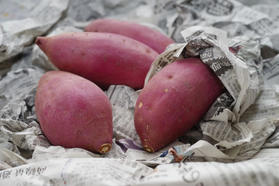 The sweet potato was introduced to Satsuma Province (present-day Kagoshima Prefecture) via the Ryukyu Kingdom (present-day Okinawa Prefecture) during the Edo period, and it became widely cultivated there. The name "satsumaimo" (sweet potato in Japanese) literally means "potato that spread nationwide from the Satsuma domain." Another name for it is "kansho," which is also its Chinese botanical name and means "sweet-tasting potato."
Sweet potatoes are not grown from seeds. Instead, they are propagated by sprouting them to create seedlings, which are then planted in fields. While the initial process of creating seedlings requires some effort, once planted, sweet potatoes grow relatively unattended until harvest. They are not prone to continuous cropping problems and are easy to cultivate. However, in overly fertile fields with high nitrogen content, the vines tend to grow excessively, hindering tuber development – a condition known as "vine growth without tuber formation." Therefore, it's important to adjust fertilizer use and keep it minimal. — From Wikipedia ー --Gemini--


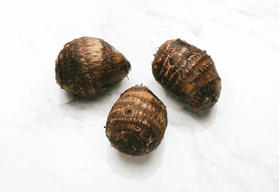 In the Okinawan dialect, taro (a perennial plant in the Araceae family) is called "Chinnuku." It is believed to have been introduced from southern regions and is valued as an auspicious food symbolizing prosperity and the flourishing of descendants, due to its abundance of small corms.
The main ways to prepare it include steaming, using it in simmered dishes, stir-fries, or as an ingredient in soups. A particularly well-known dish in Okinawa is "Chinnuku Juushi."
Chinnuku contains mucin, a slimy component that aids in the digestion and absorption of protein. Additionally, it is rich in diastase, an enzyme that breaks down starch, which makes it highly effective in promoting digestion, boosting vitality, preventing aging, improving skin health, aiding in recovery from fatigue, and alleviating constipation—offering various health benefits. (Sourced from online research)
The images displayed are borrowed from free distribution websites on the internet.
--- Translated with Copilot ----
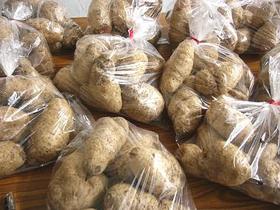 Kuganmu, or Kugaimo in the Okinawan dialect, is a wild yam belonging to the Dioscoreaceae family, genus Dioscorea, and is a type of yam. It is also known as Tokedokoro or Hariimo.
Kuga means egg in the Okinawan dialect, but it can also refer to male testicles. The origin of the name Kugaimo is uncertain, but it is thought to be due to its egg-like shape or its similar appearance.
The other name, Tokedokoro, is said to come from its thorny vines. Because the vines are covered with thorns and fine roots, it is difficult to care for and remove the soil after digging, which is why there are few farmers who produce it in Okinawa.
Kugaimo, like yam, is native to tropical Asia, and it seems that it has been cultivated in Japan only in Okinawa and Amami since ancient times. When grated, it is very sticky and can be cooked in the same way as yam. -- Gemini--
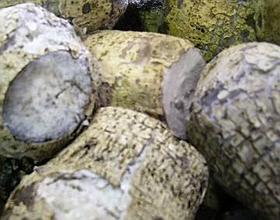 Taanmu (taro roots), also known as water taro, is a type of taro that only grows in clean water. In Okinawa, the cities of Ginowan and Kin Town are well-known for producing taanmu. Since taanmu is cultivated in rice paddies, it is not easily damaged by moles or other pests and is relatively resistant to typhoons. Because of these qualities, it was likely considered a valuable food source in the past.
 Taanmu is usually sold boiled or steamed in markets. It is rarely distributed in its raw form. The reason for this is that once harvested from the paddy fields, it spoils quickly.
Cooking the taro before selling it helps extend its shelf life and also makes it easier to distinguish high-quality taro from lower-quality ones. When steamed, the surface of the taro develops cracks, as seen in the image. Although the cracks might make the taro look damaged, they are actually a sign of good quality. In fact, I have never seen an uncracked taanmu in stores, so it is possible that ones without cracks are not distributed.
Taanmu can sometimes be found in supermarkets, but it is not always available. As a result, taanmu dishes are not commonly eaten on a daily basis in regular households. However, because taanmu continuously produces offshoots, it symbolizes prosperity and the blessing of descendants. For this reason, it is considered an auspicious food and is an essential part of Okinawan New Year celebrations and other festive occasions.
---ChatGPT---
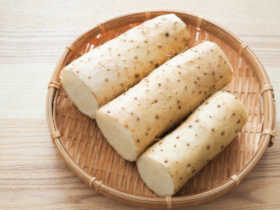 Nagaimo (Japanese yam, scientific name: Dioscorea polystachya) is a perennial climbing plant in the Dioscoreaceae (yam) family, genus Dioscorea. The term also refers to its enlarged, tuberous root. It is also known by its Chinese names shānyào(山薬) and shǔyù(薯蕷).
There are several varieties, such as Nagaimo, Tsukuneimo, and Ichōimo. Although it is sometimes grouped under the general name yamaimo (mountain yam), it is a different species from Yamanoimo(also known as Jinenjo, scientific name: Dioscorea japonica).
Crops in the yam family are widely distributed from tropical to temperate regions, with the *Dioscorea* genus being especially diverse—comprising around 600 species. Dozens of these are used as food crops. While many yam varieties thrive in tropical climates, Nagaimo can also be cultivated in colder regions.
Some believe Nagaimo was introduced to Japan from mainland China after the Middle Ages. Although several yam species grow in China, a yam identical to Nagaimo has not been identified there. It’s therefore possible that the variety currently distributed in Japan originated domestically, and it is presently referred to as Japanese Nagaimo.
Translated with Copilot (free version)
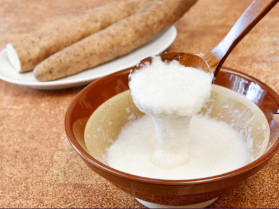
Like the Japanese yam (yamaimo), its long rhizomes are edible. It’s commonly eaten raw, either grated into a sticky paste known as tororo or thinly sliced. Grated tororo is used in dishes like mugitoro (barley rice with yam), yamakake (topped on sashimi or rice), and tororo soba (buckwheat noodles with yam), and is sometimes added to savory pancake batter like okonomiyaki to improve its texture. Because it has a higher water content and is less sticky than yamaimo, it's also well-suited for salads where its crunchy texture stands out, or simmered dishes where it takes on a fluffy, tender mouthfeel. Additionally, it's used as an ingredient in traditional Japanese sweets such as nerikiri, karukan, and jōyō manju.
Translated with Copilot (free version)


 Mail
Mail