◎ Style Change:
◎ This post was translated from Japanese with translation software.
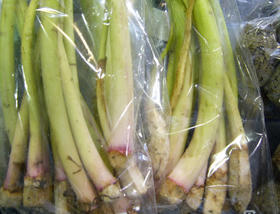 Muji refers to the stem of the taro plant.
Preparing muji requires some prep work: remove the thin fibers and cut it into appropriate pieces (3-5cm).
Note: Handling it barehanded can cause itching, so wear vinyl gloves on both hands.
Place the stems in a bowl with enough water to cover them, soak for about an hour to remove bitterness, then drain. The subsequent steps also require effort, making the preparation quite troublesome.
Mujin soup uses taro stems (muji). It is made into miso soup or clear soup with small taro tubers, pork belly, and island tofu.
In the old days, when a child was born, it was customary to make “Mujinu soup” using taro stems, considered a lucky charm, and serve it to the neighbors. Translated with DeepL.com (free version)


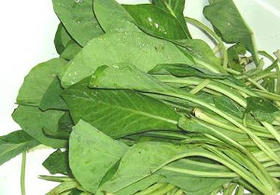 Njana, also known as Njjana, has the Japanese name Hosoba Wadan (narrow-leaved wadan) and the alternative name Nigana. It is a perennial plant in the Asteraceae family. It grows wild near the coast in central and southern Japan, which is said to be why it was given the name Wadan, meaning “sea” (wadatsumi). It was named for its narrower leaves compared to its close relative, Wadan. It belongs to a different genus within the same family as the Japanese native plant Nigana.
In Okinawan dialect, Hosobawadan is called Njanaba and is consumed as food. It has a distinctive bitterness but is said to be highly nutritious. Mixing it with oil reduces the bitterness, and it is well-known when dressed with tofu in a white sauce. When suffering from a fever due to a cold, it is simmered together with Taiyu (crucian carp) to make Taiyu Shinji, which is eaten as a decoction.
It is also used medicinally. The leaves are boiled and taken as a decoction for fever reduction, diarrhea relief, high blood pressure, and cooling the body. Translated with DeepL.com (free version)
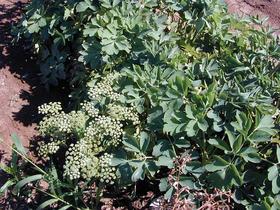 In Japan, Peucedanum japonicum is known to support longevity and have medicinal properties, and its Japanese name, chomeiso (長命草), translates to 'long-life grass'.
 Chomeiso, also known as sakuna, is used medicinally for fatigue recovery and tonic effects. The roots and young leaves are utilized; the sakuna root is finely shaved, dried, and used for medicinal purposes. Finely shredded sakuna is mixed with tofu and white miso for a miso salad. Lightly blanched sakuna is chopped and stir-fried with pork and red miso (Chinese miso is also acceptable). Additionally, sakuna's young leaves are used in dishes such as garnish for sashimi, ingredients in goat soup, tempura, and dressed salads. Translated with DeepL.com (free version)
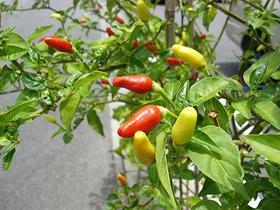 In the tropics, it is a perennial cultivated in fields. Botanically, chili peppers are classified as the same species as bell peppers, paprika, and shishito peppers; bell peppers, paprika, and shishito peppers are all cultivated varieties of chili peppers. Generally, medium-sized bell peppers with thin flesh and sweetness are called bell peppers, large-fruited varieties with thick, sweet flesh are called paprika, small-fruited varieties without pungency are called shishito peppers (shishito), and small-fruited varieties with pungency used as spices are called chili peppers.
While chili peppers are primarily cultivated in Japan, the Okinawan variety Shima-karashi (Island Chili Pepper), a type of Kida-tou-garashi, is grown in Okinawa. —From Wikipedia—
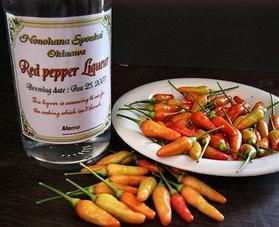
Photo 2 shows preparing to steep chili peppers in awamori. Cut off the stems of the koregusu peppers; only the fruit is steeped to prevent clouding the awamori. If the koregusu liquid level drops, top it up with more awamori. Steeping for too long will cause the peppers to lose their color, so remove them when the timing is right.
The method for making koregusu... is pretty flexible. Just put clean, dried fresh chili peppers into a No. 2 jar. You can use less koregusu than the amount shown in the photo.
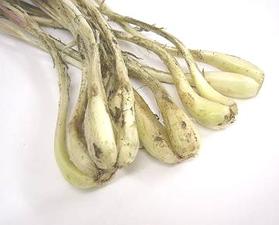 In the Okinawan dialect, *rakkyo* (Japanese shallots) are traditionally called “datchou”, though this term is mostly used by the older generation. Today, the more common name is“shima-rakkyo” or island shallots. Compared to the rakkyo grown on the mainland, Okinawa’s variety is smaller and more slender. Because shima-rakkyo is delicious when eaten raw, one might be tempted to give it a Western-style name like “shima-esharette”.
According to Wikipedia, the term “esharette” was coined by a produce wholesaler in Tokyo’s Tsukiji market to describe young, early-harvested rakkyo. The wholesaler explained, “I didn’t think ‘root-rakkyo’ would sell well, so I gave it a stylish name instead.”
Of course, this blog has no intention of confusing shima-rakkyo with esharette. On the contrary, I hope to promote the unique name shima-rakkyo more widely. It’s enjoyed in various forms—pickled in salt or vinegar, stir-fried in chanpuru, or deep-fried as tempura.
To enjoy shima-rakkyo at its best, lightly rub it with salt and let it rest overnight. Then sprinkle it with shaved bonito flakes and a dash of soy sauce for a refreshing salad-like dish. Its fragrant aroma and sharp flavor pair perfectly not only with tea but also with sake. If you rinse off the salt and store the shima-rakkyo in a container in the fridge, it will stay fresh for up to a week.
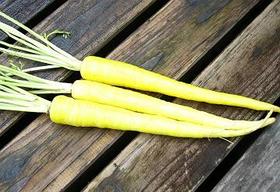 Shima-Ninjin is the Okinawan dialect name for carrots, referred to as Chideekuni (Okinawa Main Island). They are an Oriental carrot variety, believed to have been introduced to Japan via China in the 17th century. Belonging to the Apiaceae family, their roots are yellow, growing 30-40 cm long and slender like burdock. They lack the typical carrot odor, possess a sweet flavor, and are used raw or in soups, stir-fries, and simmered dishes.
In Okinawa, it is cultivated in various regions such as Itoman City, Nakagusuku Village, and Yomitan Village. Its characteristics make it suitable for diverse dishes like simmered dishes, stir-fries, and kakiage (mixed tempura fritters). Historically, it was also used as shinjimun (a decoction) in medicinal cuisine. Translated with DeepL.com (free version)
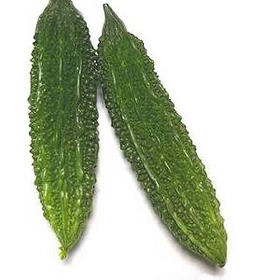 Bitter melon, or goya, is a popular name for tsuru-reishi in Japan. The name goya is more common throughout the country, while goya- (with a prolonged ending, a characteristic of the Okinawan dialect) is more widely used in Okinawa Prefecture.
Bitter melon is an annual climbing plant that can grow to be 4 to 5 meters long. Its fruit is a long, narrow spindle shape, 20 to 50 centimeters long. The skin is covered in many small bumps, and the ends are pointed. When unripe, it's green, but as it ripens, it turns yellow and soft and then splits open (this also happens if it's left at room temperature after harvest). The aril, which is the covering on the surface of the mature seeds, is a sweet, red, jelly-like substance. Even when the fruit turns yellow and soft, it's not rotten; it actually becomes sweeter and can be eaten raw. However, it loses its crisp, crunchy texture. - This information is based on Wikipedia.-
 In the Okinawan dialect, 'nabera' refers to a sponge gourd, also known as loofah.
Nabeera (loofah) is a vegetable that, along with goya(Bitter melon), adds color to Okinawan summer dining tables. While goya has recently become popular nationwide as a summer vegetable, it seems that its image as a scrubbing brush is so common that it has not been able to establish itself as a food ingredient. In Okinawa, loofah has been harvested while young and eaten as one of the summer vegetables. The main dishes are nabeera nbushi, nabeera champuru, miso soup ingredients, and ohitashi, among others.
When preparing nabeera, peel the skin thickly. If you don't peel the skin until the flesh turns white, as shown in the photo below, the outer fibers will remain hard, leaving strings in the nabeera and making it unpleasant to eat. Additionally, since young nabeera has soft seeds, they are left intact during cooking. Nabera has a subtle, refined sweetness. While goya is also a good choice for this summer, which is expected to be extremely hot, it might be worth revisiting the traditional loofah as well.
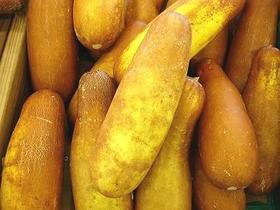 Mou-ui“ is an Okinawan dialect word meaning ”field“ or ”hair“ and ‘ui’ meaning ”melon. It is a black warty cucumber of the South China type, and is cultivated in the open (i.e., it is allowed to crawl on the ground) without supporting it.
It is said to have been brought from South China around the 15th century. In Okinawa, it is a typical summer cucumber and is sold in stores from July to October.
As you can see in the photo, maui has a reddish-brown skin with a fine mesh pattern. Its size is about the same as a petite woman's arm.
Translated with DeepL.com (free version)
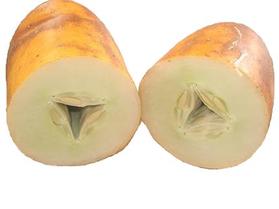
On the right is a cut of maui. The flesh is slightly thicker and the seeds are arranged in a triangular shape. It is a member of the cucumber family, but the fruit is tighter than a cucumber and has a lighter flavor and does not have a foul smell, probably because it is harvested after it is fully ripe.
A typical dish is “mawimbusi” (also called mawimbusar). Peel the skin, remove the inner flesh, cut into bite-sized pieces, fry in oil, and then simmer in miso. It can also be used as a pickle with brown sugar, sliced into thin slices and used as an ingredient in vinegared dishes and miso soup. As a vegetable introduced from China, it goes well with Okinawan and Chinese cuisine.
Translated with DeepL.com (free version)
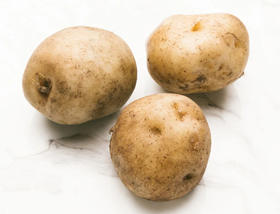 The potato (*Solanum tuberosum*) is a perennial plant in the nightshade family (*Solanaceae*), originally native to the Andes Mountains of South America. Today, it is cultivated worldwide, with its starchy underground tubers serving as a staple food.
Potatoes can be prepared in various ways, including frying, steaming, boiling, and simmering. They are also widely used in processed foods such as croquettes and potato chips, and they serve as an important source of starch. While commonly treated as a long-lasting vegetable, potatoes are also considered a staple food due to their nutritional value, containing essential nutrients like vitamin C and potassium.
However, caution is needed when consuming potatoes, as sprouted eyes or green-tinged skin from exposure to light may contain harmful substances. As one of the most widely consumed foods globally, potatoes play a significant role in diets across cultures.
Reference: Wikipedia


 Mail
Mail