◎ Style Change:
◎ This post was translated from Japanese with translation software.
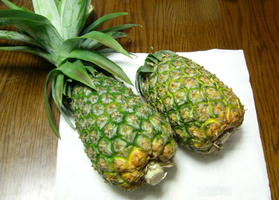 The pineapple (Pineapple, Pineapple, Ananas comosus) is a perennial plant of the pineapple family, or its enlarged fruit, native to tropical America. It is sometimes referred to simply as pineapple, and its Chinese name is pineapple (菠蘿), pineapple (菠蘿) or pineapple (鳳梨) (Houli, Onlai, Fongli). In mainland China and Hong Kong, it is called pineapple (菠蘿), while in Taiwan it is called fengli (鳳梨). The botanical name is also sometimes used to refer to the plant as Ananas, and only the fruit or edible parts are sometimes referred to as pineapple to distinguish it from other species. The name pineapple originally referred to the pine fruit (apple), or pine cone. Around the 18th century, the name was changed to the fruit of this species, which has a similar appearance. Production is increasing, mostly from Costa Rica, the Philippines and Brazil, and the fruit has a sweet flavour and lots of juice.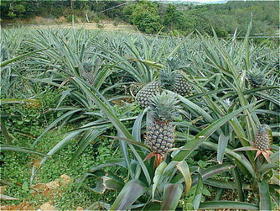
The leaves grow in clusters from underground stems and are sword-shaped and stiff, with or without thorns on the edges. Seedlings are propagated from suckers with well-developed axillary buds at the base of the leaves.
12-18 months after planting, spikelets emerge from the centre of the plant, with a 60 cm to as long as 100 cm flower shaft with a cylindrical inflorescence at the tip, containing about 150 flowers. The flowers are arranged in a spiral pattern on the inflorescence, with three outer petals and three inner petals, typical of a monocotyledonous plant. The petals are fleshy, white in colour with a light purple tip. Fruiting occurs in about 6 months after flowering, with or without pollination. After fruiting, the true fruit, which is derived from the cotyledon, fuses with the saucer at the base of each individual flower and even the inflorescence axis to form an enlarged, so-called 'pineapple'. The true fruit is the hard, spirally arranged part of the fruit surface, and when the fruit part is peeled off like a skin, brown seeds the size of sesame seeds may be seen between the pulp and the fruit. [From Wikipedia.]




 Mail
Mail