◎ Style Change:
◎ This post was translated from Japanese with translation software.
Fruit wine
2023.07.02
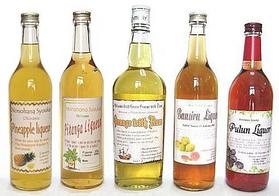 I have tried making various fruit liquors and it seems that if you are not careful about sterilising and storing the bottles etc., they can become harsh taste.
Basically, it seems that if you use a liquor with a high degree of alcohol, you don't have to worry about the expiry date, but depending on the fruit, there are cases where the aroma and taste may change if it is stored for a longer period of time. Furthermore, you have to be careful about where you store them, and of course a cool, dark place is the basic rule.
Another thing to bear in mind when make fruit wine is that it is fine to make it for personal consumption, but it is forbidden to sell it or serve it to customers in a shop. The tricky part is with grapes, because of the Liquor Tax Law, you cannot make fruit wine, even for personal consumption purposes.
If you search for fruit wine on the internet, you will find information on how to make it, various ways to enjoy it and precautions to take.


Prune liquor
2023.06.07
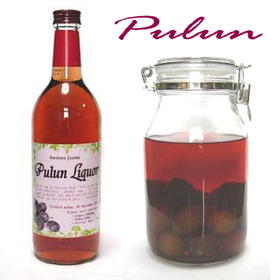 Prune (Rosaceae, Japanese name: Western peach.) originate from the Caucasus region. It spread to Europe, America and Oceania via Greece. In Japan, it is grown in Nagano, Aomori and Hokkaido. -From internet search.
600 g prunes (from Aomori), 120 g rock sugar, 1 litre white liquor.
Prunes are not a fruit native to Okinawa, but as all the fruit wine so far has been amber-coloured, I wanted a fruit wine with a slightly different colour, so I tried soaking prunes. As expected, a reddish-purple colour starts to appear as soon as possible.
Two weeks after pickling the prunes, the wine-like colour of the liquor and especially the aroma is excellent. The third week after pickling, the fruit is removed and the prune liquor is bottled. However, according to some, it is better not to leave the fruit wine too long.
Prune wine is reddish purple in colour (slightly reddish purple), the aroma is good with a unique smell like a mixture of plum wine and grape wine, and the taste is mild.
Blueberry liquor
2023.05.22
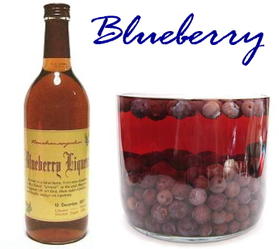 Blueberries are not a local product of Okinawa, but while preparing fruit wine, I was curious about blueberries and wondered what they would be like when made into fruit wine, so I gave it a try.
I soaked the blueberries I got from the supermarket in rock sugar and white liquor as usual. Over time, the colour comes out very nicely, although the aroma is not so great.
The colour became so bright, clear and reddish-purple that the eye could have thought it was red grape wine. The sweet and sour blueberry wine may be recommended with carbonation.
Mandarin orange wine (esp. Citrus unshiu)
2023.04.42
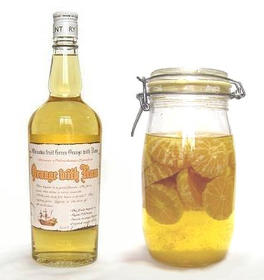 Aoikiri tangerines, a speciality of Okinawa, are harvested shortly before they turn colour, in order to make the most of the spectacular acidity of Onshu tangerines.
This time, rum (40°) is used for the green-cut tangerines. The green-cut tangerines have become clear and pale yellow in colour with the passage of time after soaking.
The difference between white liquor and rum does not seem to make much difference visually. The taste is quite alcoholic with the quintessential rum. I think it takes about a month to finish, but I still wonder if I leave it too long, it will turn into a sweet rum as it has a lot of rock sugar in it.
Pineapple liquor
2023.03.02
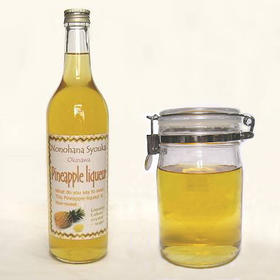 I chopped pineapple and soaked it in white liquor. For a while after soaking, there was a pineapple aroma, but as time went on, the aroma gradually became weaker. That gave it a pineapple colour like a fruit wine, but I am not sure if it will taste better, so we will see how it goes a little longer.
The pineapple wine smelled like pineapple wine up to one or two months, but after three months, the aroma was almost gone and it started to taste like a liquor with the sweetness of rock sugar.
My personal opinion is that fruit wine is probably not meant to be left for very long. The colour of the fruit remains, but the aroma is gone and only the sweetness remains.
Citrus keraji var
2023.02.22
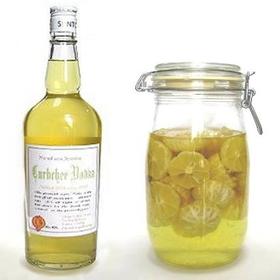 It is the season for Citrus, which are quickly bought and used to make fruit wine. 500 g kābūti (without the peel), 6 pieces of peel for flavouring, 100 g rock sugar, 720 ml vodka (Smirnoff 40°).
Vodka, a Scandinavian liquor, and kerbchi, a tropical fruit, are pickled in the hope that it will be a delicious combination. What concerns me a little is that the kābči is sweet and has little acidity. First, let's see how it progresses.
In Okinawa, carbuchi, a native Okinawan citrus fruit, is sold at markets, supermarkets and roadside stalls around October-November. They are harvested while the skin is still green and are about the size of a Onshu mandarin orange. According to one theory, they are called kabuchi because of their thick skin. It has a thick skin and a strong aroma, a rugged appearance, and has few seeds and little juice. However, it tastes sweeter and tastier than its strong aroma and appearance.
The aroma of the kābūti blends into the vodka and is intense. Citrus fruit wine's aroma weakens with time, so it might be better if this much aroma remains. The colour of the liquor is yellow with light greenish tints.
With time, it changes to an amber colour and the aroma of kābūti disappears, becoming the aroma characteristic of citrus fruit wine. Delicious, the kābūti aroma or faintly lingers after drinking. Bottled and labelled immediately.
Guava wine
2023.01.02
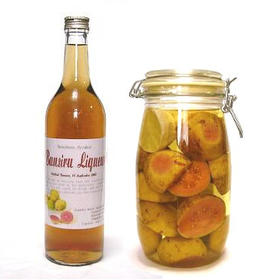 Guava liquor (bansilu liquor) prepared.
600 g guava (bansilu) fruit, 1 lemon (without peel), 200 g rock sugar, 700 mg white liquor.
The banshiru alone is a little weak in acidity, so I added a peeled lemon to sweeten it a little.
I would be happy if the aroma remains, but we'll wait and see what the result is in three months' time.
In the third week of soaking the guava (bansilu), the white liquor did not colour very well at the beginning of soaking, but it finally started to turn an amber colour in the third week. The taste is mellow and the banshiru aroma is still present.
The banshiru liquor is bottled and allowed to mature. When bottled, it is amber in colour (lighter than whisky), with a weak banshiru aroma and a mellow taste.
Iced coffee
2018.09.19
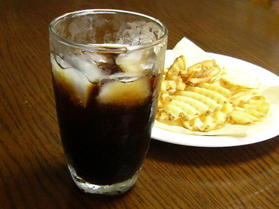 Iced coffee is a coffee beverage served cold. It may be prepared either by brewing coffee normally (i.e. carafe, French press, etc.) and then serving it over ice or in cold milk or by brewing the coffee cold. In hot brewing, sweeteners and flavoring may be added before cooling, as they dissolve faster. Iced coffee can also be sweetened with pre-dissolved sugar in water.
Iced coffee is regularly available in most coffee shops. Iced coffee is generally brewed at a higher strength than normal coffee, given that it is diluted by the melting ice. In Australia, "iced coffee" is a common term for packaged coffee-flavored and sweetened milk beverage.
In Japan, iced coffee originated during the Meiji period (1868-1912) when people started drinking coffee cold. At that time, it was called cold coffee. The term "iced coffee" or "cold coffee" was often used in the Kansai region (before the 1980s). This is an abbreviation for "cold coffee," and before that it was also called "cold coffee.
ーWikipediaー


 Mail
Mail