◎ Style Change:
◎ This post was translated from Japanese with translation software.
 Yams are perennial herbaceous vines native to Africa, Asia, and the Americas and cultivated for the consumption of their starchy tubers in many temperate and tropical regions. The tubers themselves, also called "yams", come in a variety of forms owing to numerous cultivars and related species. -Wikipedia-
In Yomitan Village and Uruma City, where yam production is flourishing, there is an industrial festival called “Yams-Suubu,” in which contestants compete in the total weight of yams produced from a single seed potato.
At the festival site, fresh yams are sold, and the purchased yams are carried by wheelbarrows and handcarts. Also, large yams were cut into small pieces and sold in small lots.
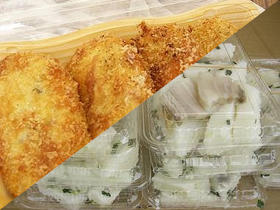
At the food booths, steamed yams, packs of tripe and yam croquettes were on sale, and we bought a pack of each, which looked delicious, and ate them in the tent for a break.
Translated with DeepL.com (free version)
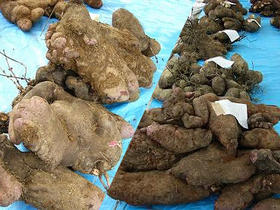
One share of yam yields 40 to 50 kilograms, which is a high yield per unit area. The total weight of a single yam plant exhibited at the “Yams-Suubu” is well over 100 kg, proving its high productivity, and the yam in the picture looks like a baseball glove.
According to a person who exhibits at the Yams-Suubu every year, the best way to grow large yams is to start by preparing the soil.
Translated with DeepL.com (free version)


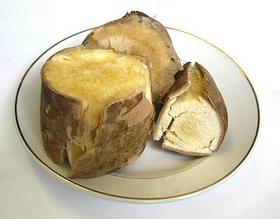 In Okinawa, cassava rhizomes are called “keeum. Cassava (scientific name: Manihot esculenta) is a tropical shrub of the genus Imonoki in the family Euphorbiaceae. It is also called manioc and manjoca. The sweet potato is the source of tapioca, which is cultivated in tropical regions around the world. (From Wikipedia, the free encyclopedia)
Cassava comes in bitter and sweet varieties, and the steamed keum (cassava potato) in the photo is the sweet variety. The outer skin contains cyanide compounds, but the sweet species has fewer compounds and can be eaten by steaming or boiling. Its texture is similar to that of sweet potatoes, but even though it is a sweet species, it is less sweet than sweet potatoes.
Translated with DeepL.com (free version)
Since it is a tropical plant, its cultivation in mainland Japan is rare. In Okinawa, it seems to have been actively cultivated before World War II, due to the government's encouragement to increase food production.
Kiasaba, which is resistant to drought and can grow in acidic and nutrient-poor soils, has been attracting attention in recent years as a food problem, a countermeasure against global warming, and for use as biofuel, etc., since its yield per unit area is higher than that of other starch crops.
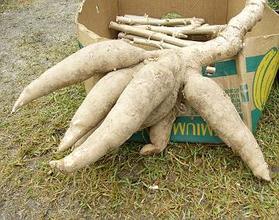
The photo on the left shows a keyum (cassava potato). One keyum is about the size of a woman's arm. This size is the best for eating as a potato, and when taking starch as a raw material for tapioca, it is grown thicker and larger.
Translated with DeepL.com (free version)
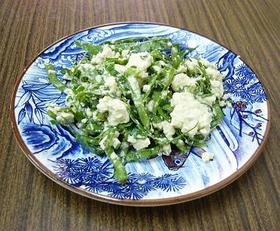 It is a bitter leafy vegetable, known as njana or njana bar (bitter greens) in the Okinawan dialect.
In the past, when I had a cold and a fever, I stewed crucian carp and njana together and ate them as a decoction of crucian carp (stewed fish). It was not a tasty dish, but somehow it seemed to help.
The photograph shows ndjanaayi (boiled ndjana). Boil the njana lightly in salted water, drain and chop finely. It is then mixed with well-drained island tofu and dressed with white dressing. To season, add salt, soy sauce, sesame oil and white miso to taste and mix well. Njana is said to be a medicine for the stomach and intestines, and njanaayi is ideal for summer fatigue and loss of appetite.
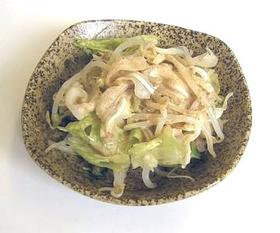 Mimigar (skin of pig's ear) is crunchy and delicious. Once you try it, you will become addicted to it. Mimigarh is made by boiling pork ears and slicing them thinly.
Mimigarh sashimi is made with lightly boiled bean sprouts and cucumbers with vinegared miso paste, or with peanut butter mixed with vinegar, sugar, myrin, and soup stock.
It is ideal as a snack with beer or sake. The crunchy texture is the cartilage of the pig's ear, which contains a lot of collagen and is considered a healthy food. It is not only used as an appetizer, but also as an ingredient in champuru dishes.
Pictured is a mimiga salad of boiled bean sprouts and lettuce with sesame dressing.
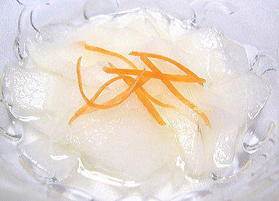 Vinegared daikon radish is called dekuninamashi in the Okinawan dialect. Daikon in season is thinly sliced with ama-zu (sweet vinegar) (the photo shows thinly sliced). The ama-zu is made by mixing vinegar, water (or light soup stock) and sugar.
It is slightly more acidic than usachi (see previous blog post). If you don't care about the color of the dekuninamashi, you can add a few drops of soy sauce. Rather than eating it immediately after making it, refrigerate it for a while so that the juice from the daikon and the sweet vinegar will meld together and give it a nice flavor.
You can use lemon or sequoar for flavoring if you like, but in my case, I don't, because it would ruin the flavor of the daikon. For garnish, shaved dried bonito shavings. In the photo, carrots are garnished.
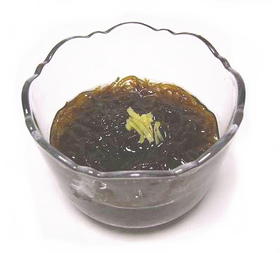 Mozuku is called "sunui" in the Okinawan dialect. The etymology of the word comes from the fact that it is eaten as a vinegared dish, and vinegar and nori are said to have come together to form the name of vinegared nui. (Nui means "laver.")
It is very similar to mozuku collected in the mainland, but they seem to differ in terms of subject and genus classification. The demand for mozuku increased due to the natural food boom, and mozuku cultivation was studied in Kagoshima and Okinawa, reaching its peak around 1980 in Okinawa.
Mozuku's well-balanced content of polysaccharides (dietary fiber), fucoidan, alginic acid, fucooligosaccharides, and other vitamins and minerals has attracted attention as a health food that helps prevent lifestyle-related diseases.
Sanbaizu is the most common way to eat mozuku as a vinegared dish. Many people have tried various ways of flavoring vinegar and condiments to their liking. Tempura is also a delicious way to eat mozuku other than as a vinegared dish.
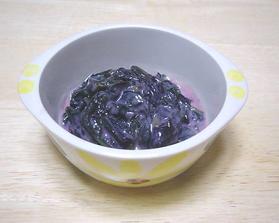 A perennial herb of the Asteraceae family that is believed to have been introduced to Japan from its native tropical Asia via China. Its Japanese name is "suizenji-shi", "kinjisusa", "shikibuso", "harutama", etc. It is also called "shikibu" in Japanese.
The photo shows handama dressed with vinegared miso. Boil 200 g of leaves, drain off the hot water, cool in cold water, and drain off the water. This is the same way to boil leafy greens.
For the vinegared miso, sweet white miso is recommended. The amount of vinegared miso is up to you. I use 2 tablespoons white miso, 1 tablespoon sugar, 1 teaspoon vinegar, and a little mirin to make it a little sweet.
Boiled handama are black in color, but the anthocyanin pigmentation from the vinegar adds to the color. When served over rice, the vinegar and miso mixture will give the rice a beautiful purple color. (Based on 4 servings)
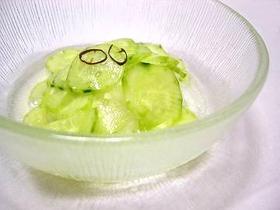 Vinegared cucumbers are a simple and easy to make dish. Thinly slice cucumbers. Then, pour the ama-zu (sweet vinegar), which is made by diluting vinegar with water and adding sugar and myrin, over the slices.
As one would expect, this alone is tasteless, so add a few drops of citrus juice (or lemon) to flavor the ama-tsuyu. In the picture, I put some chili peppers on top, but this is optional. I put it on for me to eat later.
Dilute the sweet vinegar so that you can drink the juice as is. If you make usachi and refrigerate it for a while, the water from the cucumber mixes with the sweet vinegar, making it refreshing and very tasty.
In the old days, when there was usachi at a festive meal, I drank all the juice, and was chided for my bad manners, but I couldn't resist the taste of usachi.
But the taste of usachi was so good that I couldn't resist... As an easy and tasty way. Dilute commercially available sushi vinegar with water, add a little sugar, and a few drops of lemon concentrate to make it homemade. It's completely lazy, but I recommend it as a dish that brings coolness to your summer table.
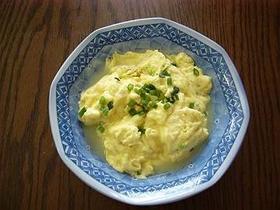 Tamaguburu, a dish of Okinawan home cooking, is made with eggs in the form of dough. It is the Okinawan version of scrambled eggs, made with beaten eggs, bonito broth, chives, a pinch of salt, and a little sesame oil for flavor.
You can add chopped nori (seaweed) or shichimi (seven spices) if you like. Chawanmushi requires a lot of time and effort, but this dish is very easy to prepare and is similar to scrambled eggs. Instead of milk used for scrambled eggs, Tamagou Blue uses dashi broth.
As a side note, it is recommended to use two eggs, although it can be done with one, but for a fluffier texture, use more than two eggs for a better taste.
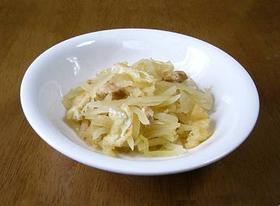 Papaya originates from subtropical Central America, Papiaceae, herbaceous evergreen fruit tree. In Okinawa, many families plant papaya in their gardens for both ornamental and practical use.
Papaya ili chi, or papaya ili chi, is made by stir-frying green papaya with pork. It is usually called papaya, but in Okinawa (the main island), papaya is the common name, so here it is called papaya iliçi. It is very tasty and has a firm texture.
To prepare papaya iliçi, peel green papayas, split them in two lengthwise and remove the seeds inside. Cut the fruits into strips and soak them in water for a while to drain off the bad smell. Boil pork chops and cut into strips.
Heat salad oil in a frying pan (or wok), add the pork, and when the fat from the meat has melted, add the shredded papaya. Add the dashi broth (pork broth or bonito broth), season with salt and soy sauce, and cook until all the liquid is absorbed. (Add a little fried tofu to the papaya ili chi in the photo (to keep the papaya crispy), and cook until all the broth is absorbed.
Papaya is eaten as a fruit, but the green, unripe fruit is used as a vegetable substitute. The unripe fruit contains vitamin C, calcium, and papain enzyme, which is very helpful in protein digestion and breakdown. Papayas are a good fruit tree because they produce fruit all year round, and papayas are large and bountiful when vegetables are scarce.
In the old days, papayas were said to improve milk supply because of their shape, and pregnant women were often fed them. It is a wonderful example of the wisdom of life that has been passed down from generation to generation.


 Mail
Mail