◎ Style Change:
◎ This post was translated from Japanese with translation software.
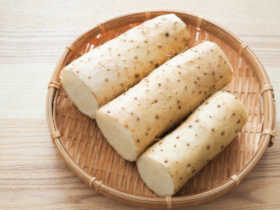 Nagaimo (Japanese yam, scientific name: Dioscorea polystachya) is a perennial climbing plant in the Dioscoreaceae (yam) family, genus Dioscorea. The term also refers to its enlarged, tuberous root. It is also known by its Chinese names shānyào(山薬) and shǔyù(薯蕷).
There are several varieties, such as Nagaimo, Tsukuneimo, and Ichōimo. Although it is sometimes grouped under the general name yamaimo (mountain yam), it is a different species from Yamanoimo(also known as Jinenjo, scientific name: Dioscorea japonica).
Crops in the yam family are widely distributed from tropical to temperate regions, with the *Dioscorea* genus being especially diverse—comprising around 600 species. Dozens of these are used as food crops. While many yam varieties thrive in tropical climates, Nagaimo can also be cultivated in colder regions.
Some believe Nagaimo was introduced to Japan from mainland China after the Middle Ages. Although several yam species grow in China, a yam identical to Nagaimo has not been identified there. It’s therefore possible that the variety currently distributed in Japan originated domestically, and it is presently referred to as Japanese Nagaimo.
Translated with Copilot (free version)

Like the Japanese yam (yamaimo), its long rhizomes are edible. It’s commonly eaten raw, either grated into a sticky paste known as tororo or thinly sliced. Grated tororo is used in dishes like mugitoro (barley rice with yam), yamakake (topped on sashimi or rice), and tororo soba (buckwheat noodles with yam), and is sometimes added to savory pancake batter like okonomiyaki to improve its texture. Because it has a higher water content and is less sticky than yamaimo, it's also well-suited for salads where its crunchy texture stands out, or simmered dishes where it takes on a fluffy, tender mouthfeel. Additionally, it's used as an ingredient in traditional Japanese sweets such as nerikiri, karukan, and jōyō manju.
Translated with Copilot (free version)




 Mail
Mail