◎ Style Change:
◎ This post was translated from Japanese with translation software.
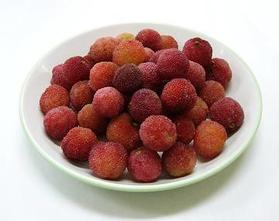 Known as mumu (or mijimu) in the Okinawan dialect, the Japanese name is yamamomo, an evergreen tree of the yamamomo family.
Its Japanese name comes from the fact that it grows in the mountains and bears peach-like fruits. It is also known as “yangbai,” “yama-sakura-momo,” and “hi-jitsu,” and has been used in waka poems since ancient times. It is dioecious, and produces small, inconspicuous red flowers in clusters of beads from March to April. The fruits are almost spherical, dark red, and densely covered with glabrous granules on the surface. (For more information about the mountain peach, see Wikipedia, the free encyclopedia.)
The fruits are soft, moist, sweet and sour, and are delicious when eaten with a little salt, just like watermelon.
The fruit trees grow large and are used as roadside trees in some areas, but when the fruits ripen and fall, they are trampled and the area around the trees turns black.
Translated with DeepL.com (free version)


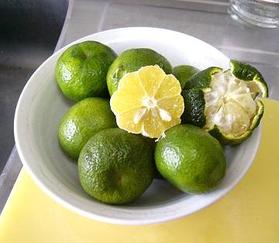 Kabuchii (scientific name: Citrus keraji var. kabuchii hort.ex Tanaka) is a citrus fruit native to Okinawa, belonging to the tangerine family. The name means “thick skin.
It is a small orange with a diameter of 4-5 cm, and although it is not very attractive due to its rough appearance, it has a distinctive aroma and a refreshing sweetness. As its name suggests, the peel is thick and floating, making it easy to peel, but the edible portion is small and the yield is low, so its commercial value is not high. It is also difficult to eat because it is a wild variety and has many seeds. Because of its early maturity and rapid acid loss, it is harvested in green slices from October to early November. Production is about 60 tons, most of which is consumed within the prefecture. Wikipedia
Okinawa's native “kabuchee” was originally cultivated throughout Okinawa, but due to various factors, the focus of cultivation is said to have shifted to Yanbaru (the northern region of Okinawa's main island). It was called “field day tangerine” because the harvest season was in October, which was the field day season in Okinawa Prefecture during the Showa period. Translated with DeepL.com (free version)
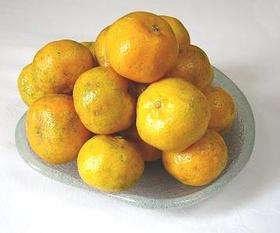 One of Okinawa's citrus fruits called kugani, it is about the same size as or slightly larger than the shiksa, and when fully ripe, it is sweet and delicious. It is harvested from December to January. Ogimi kugani and Katsuyama kugani are the most famous.
There are many strains of kunibu or kunibungi (kunibungi in Okinawan dialect is thought to come from a nine-year tree) citrus fruits, and it is said that there are several strains including Ishikunibu, Hijakunibu, Kaachii, and Kaavisii in addition to the representative seekers, and kugani is an improved version of them. The kugani is called kugani (meaning “golden” in Okinawan dialect) because of the golden color of its rind when ripe.
The sweet and tasty kugani has been popular since long ago, and folk tales tell of the origin of its name, such as the “golden kitten” in Yonabaru and the “kugani tree” in Kinmu Town.
Translated with DeepL.com (free version)
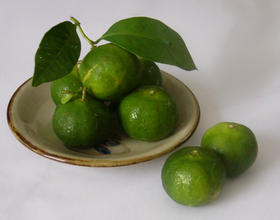 Also written as "shikwasa" or "shikwasa. Japanese name: Hirami lemon, scientific name: Citrus depressa, is an evergreen shrubby citrus fruit of the tangerine family (Wikipedia, the free encyclopedia for scientific names). It is a small citrus fruit native mainly to Okinawa, with greenish skin, highly acidic while unripe, and moderately sweet when ripe to yellow, but still more acidic than the tangerine and similar to the lemon. Typical Shikwasa strains are Ishikunibu (stone 9 years old tree), Husubuta (thick navel), Tanebuto (large seeds), Mikangwa (small tangerine), Ingwakunibu (dog 9 years old tree), Hijakunibu (goat 9 years old tree), Kaaachi (thick skin), Kaabishee (thin skin), etc., and their fruit sizes There are also several other varieties.
Shikwasa was once used as a substitute for detergent to wash bashofu (Japanese banana cloth). In recent years, the nobiletin, a type of flavonoid found in shikwasa, has been attracting attention and has become a popular fruit. In Okinawa, shikwasa is not only a health food, but is also used in many other products from seasonings to confectionaries. Translated with DeepL.com (free version)
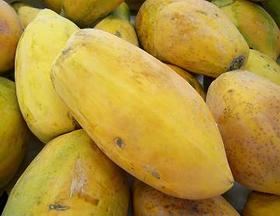 The fruit is a large berry about 15–45 cm long and 10–30 cm in diameter. It is ripe when it feels soft (as soft as a ripe avocado or softer), its skin has attained an amber to orange hue and along the walls of the large central cavity are attached numerous black seeds.
Papaya skin, pulp, and seeds contain a variety of phytochemicals, including carotenoids and polyphenols,as well as benzyl isothiocyanates and benzyl glucosinates, with skin and pulp levels that increase during ripening. The carotenoids, lutein and beta-carotene, are prominent in the yellow skin, while lycopene is dominant in the red flesh. Papaya seeds also contain the cyanogenic substance prunasin. The green fruit contains papain, a cysteine protease enzyme used to tenderize meat. (From Wikipedia)
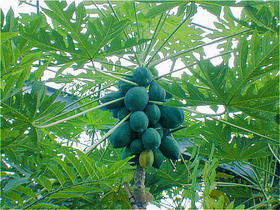
Papayas are dioecious. The flowers are five-parted and highly dimorphic; the male flowers have the stamens fused to the petals. There are two different types of papaya flowers. The female flowers have a superior ovary and five contorted petals loosely connected at the base.
Male and female flowers are borne in the leaf axils; the male flowers are in multiflowered dichasia, and the female ones are in few-flowered dichasia. The pollen grains are elongated and approximately 35 microns in length. The flowers are sweet-scented, open at night, and are wind- or insect-pollinated. (From Wikipedia)
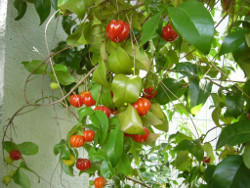 From Wikipedia, the free encyclopedia
The Suriname cherry, also known as the Brazilian cherry, is a flowering plant belonging to the Myrtaceae family. Its edible fruit is classified as a botanical berry, with flavors ranging from sweet to sour depending on the cultivar and ripeness. The darker red to black fruits are notably sweet, while those in the green to orange range are distinctly tart. The primary culinary application of the fruit is as a flavoring agent and a base ingredient for jams and jellies. Additionally, the fruit is rich in vitamin C and serves as a source of provitamin A.
Eugenia uniflora has several significant pharmacological properties. Its essential oil is antihypertensive, antidiabetic, antitumor and analgesic, and it has shown antiviral and antifungal activity. It has performed against microorganisms such as Trichomonas gallinae (in vitro), Trypanosoma cruzi and Leishmania amazonensis.
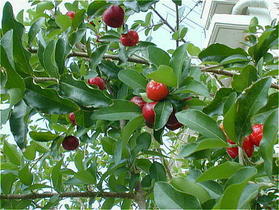 An evergreen shrub native to the West Indies, northern South America, and Central America, it produces edible cherry-like fruits with bright red skins. The leaves are entire (without serrated leaves) and about 10 cm long. The fruits are small (5-8 grams), with red skin and pale yellow or red flesh. The shape of the fruit gives it the alias Barbados cherry, but according to the APG IV classification, the acerola is a member of the Kytranychidae family, which is taxonomically distant from the cherry, which is a member of the Rosaceae family. The fruit can be divided into two types: acidic (sour) and sweet (sweet). Nutritionally, it is rich in vitamin C, which is 17 times richer than that of lemons, and also contains carotene, vitamins B1 and B2, and vitamin E, among others. It is mainly processed into soft drinks, jams, and jellies. However, ripe fruits are rarely sold commercially because they are easily damaged, and unripe fruits are used for processing.
In Japan, it was introduced to Okinawa Prefecture in 1958 and has been cultivated there ever since. Currently, it is sold as a processed product as Nichirei Acerola Drink by Suntory Foods, and is widely used by the general public. It is also used as a beverage in Brazil, where the flavor of the acerola itself can be strongly felt. However, the taste of acerola itself is not so strong in Japanese beverages, as it is diluted considerably. (From Wikipedia Translation is Deepl)
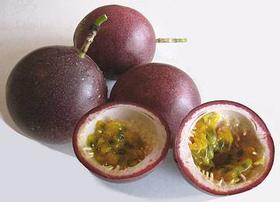 As of 2010, a few dozen species selected and bred for their edible berries are grown in a wide range of tropical and subtropical regions of the world. Brazil is the largest producer, with the majority of cultivation in surrounding Central and South America. It is also cultivated in Taiwan, Indonesia, and other Southeast Asian countries.
In Japan, it has long been cultivated mainly in the Nansei Islands centering on the Amami Islands, the islands of Tokyo, Kagoshima Prefecture, and Okinawa Prefecture. Kagoshima Prefecture is the largest in Japan in terms of both cultivated area and production, but cultivation is also flourishing in Kumamoto, Gifu, Tokyo, Nagano, Tochigi, Fukushima, and other prefectures. Most of these cultivations are done in greenhouses, but open-air cultivation is also possible, and it has been cultivated in many places for a long time. In recent years, it has been cultivated in open fields in Chiba and Gifu prefectures.
In Japan, cultivation is generally divided into three types: purple, yellow, and intermediate hybrids, with the purple variety, which has a strong sweetness, in high demand for fresh eating. The yellow variety is more robust and juicy, and is often grown as a raw material for processing around the world. ー From Wikipedia ー Translated with DeepL.com (free version)
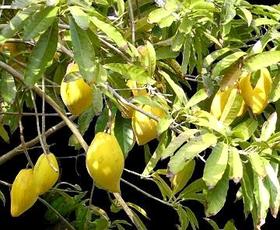 Pouteria campechiana (commonly known as the cupcake fruit, eggfruit, zapote amarillo or canistel) is an evergreen tree native to, and cultivated in, southern Mexico, Belize, Guatemala, and El Salvador. It is cultivated in other countries, such as India, Costa Rica, Brazil, the United States, the Dominican Republic, Australia, Cambodia, Vietnam, Indonesia, Sri Lanka, Nigeria, and the Philippines. The edible part of the tree is its fruit, which is colloquially known as an egg fruit.
The canistel grows up to 10 m (33 ft) high, and produces orange-yellow fruit, also called yellow sapote, up to 7 cm (2.8 in) long, which are edible raw. Canistel flesh is sweet, with a texture often compared to that of a hard-boiled egg yolk, hence its colloquial name "eggfruit". It is closely related to the lucuma, mamey sapote, and abiu. From Wikipedia, the free encyclopedia
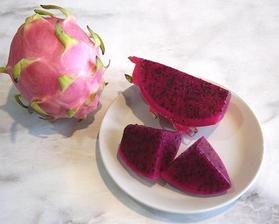 We are uploading dragon fruit in honor of this year's Chinese zodiac sign, the Year of the Dragon. Also known as dragon fruit or pitaya (pitaya is the generic name for the fruit of the cactus). It is the fruit of the sangkak cactus, a member of the family Cactaceae, and originates from Central and South America. The smallest fruit is about the size of a woman's fist, and the largest is about the size of a man's fist. The rind is a bright reddish pink and the flesh is often white and red.
The pulp is jelly-like, and the black seeds are entirely covered like sesame seeds, making it impossible to separate the pulp from the seeds. Therefore, the seeds are eaten with the pulp, so the texture is crunchy. Some dragonfruits have red pulp, while others have yellow-colored rind. (DeepL free version)
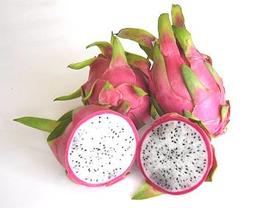
The second photo shows a dragon fruit with white flesh. The color is not as good as expected due to poor photography, but it is clear and beautiful white. The seeds are still sesame-like, so they are eaten together with the pulp.


 Mail
Mail