◎ Style Change:
◎ This post was translated from Japanese with translation software.
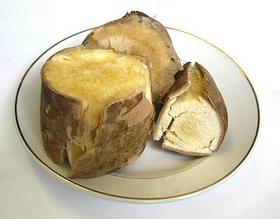 In Okinawa, cassava rhizomes are called “keeum. Cassava (scientific name: Manihot esculenta) is a tropical shrub of the genus Imonoki in the family Euphorbiaceae. It is also called manioc and manjoca. The sweet potato is the source of tapioca, which is cultivated in tropical regions around the world. (From Wikipedia, the free encyclopedia)
Cassava comes in bitter and sweet varieties, and the steamed keum (cassava potato) in the photo is the sweet variety. The outer skin contains cyanide compounds, but the sweet species has fewer compounds and can be eaten by steaming or boiling. Its texture is similar to that of sweet potatoes, but even though it is a sweet species, it is less sweet than sweet potatoes.
Translated with DeepL.com (free version)
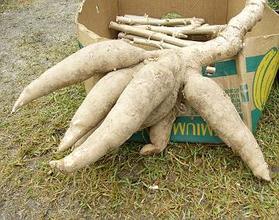
Since it is a tropical plant, its cultivation in mainland Japan is rare. In Okinawa, it seems to have been actively cultivated before World War II, due to the government's encouragement to increase food production.
Kiasaba, which is resistant to drought and can grow in acidic and nutrient-poor soils, has been attracting attention in recent years as a food problem, a countermeasure against global warming, and for use as biofuel, etc., since its yield per unit area is higher than that of other starch crops.
The photo on the left shows a keyum (cassava potato). One keyum is about the size of a woman's arm. This size is the best for eating as a potato, and when taking starch as a raw material for tapioca, it is grown thicker and larger.
Translated with DeepL.com (free version)



 Mail
Mail