◎ Style Change:
◎ This post was translated from Japanese with translation software.
Acerola
2024.04.07
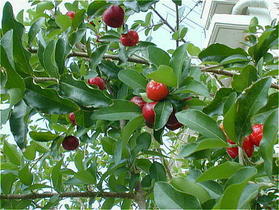 An evergreen shrub native to the West Indies, northern South America, and Central America, it produces edible cherry-like fruits with bright red skins. The leaves are entire (without serrated leaves) and about 10 cm long. The fruits are small (5-8 grams), with red skin and pale yellow or red flesh. The shape of the fruit gives it the alias Barbados cherry, but according to the APG IV classification, the acerola is a member of the Kytranychidae family, which is taxonomically distant from the cherry, which is a member of the Rosaceae family. The fruit can be divided into two types: acidic (sour) and sweet (sweet). Nutritionally, it is rich in vitamin C, which is 17 times richer than that of lemons, and also contains carotene, vitamins B1 and B2, and vitamin E, among others. It is mainly processed into soft drinks, jams, and jellies. However, ripe fruits are rarely sold commercially because they are easily damaged, and unripe fruits are used for processing.
In Japan, it was introduced to Okinawa Prefecture in 1958 and has been cultivated there ever since. Currently, it is sold as a processed product as Nichirei Acerola Drink by Suntory Foods, and is widely used by the general public. It is also used as a beverage in Brazil, where the flavor of the acerola itself can be strongly felt. However, the taste of acerola itself is not so strong in Japanese beverages, as it is diluted considerably. (From Wikipedia Translation is Deepl)




 Mail
Mail