◎ Style Change:
◎ This post was translated from Japanese with translation software.
papaya
2024.06.03
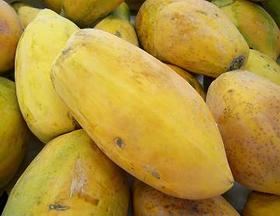 The fruit is a large berry about 15–45 cm long and 10–30 cm in diameter. It is ripe when it feels soft (as soft as a ripe avocado or softer), its skin has attained an amber to orange hue and along the walls of the large central cavity are attached numerous black seeds.
Papaya skin, pulp, and seeds contain a variety of phytochemicals, including carotenoids and polyphenols,as well as benzyl isothiocyanates and benzyl glucosinates, with skin and pulp levels that increase during ripening. The carotenoids, lutein and beta-carotene, are prominent in the yellow skin, while lycopene is dominant in the red flesh. Papaya seeds also contain the cyanogenic substance prunasin. The green fruit contains papain, a cysteine protease enzyme used to tenderize meat. (From Wikipedia)
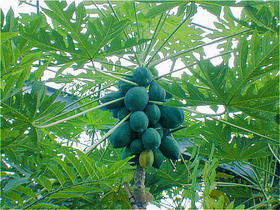
Papayas are dioecious. The flowers are five-parted and highly dimorphic; the male flowers have the stamens fused to the petals. There are two different types of papaya flowers. The female flowers have a superior ovary and five contorted petals loosely connected at the base.
Male and female flowers are borne in the leaf axils; the male flowers are in multiflowered dichasia, and the female ones are in few-flowered dichasia. The pollen grains are elongated and approximately 35 microns in length. The flowers are sweet-scented, open at night, and are wind- or insect-pollinated. (From Wikipedia)




 Mail
Mail