◎ Style Change:
◎ This post was translated from Japanese with translation software.
Taro
2025.02.10
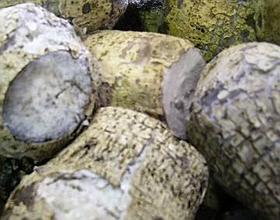 Taanmu (taro roots), also known as water taro, is a type of taro that only grows in clean water. In Okinawa, the cities of Ginowan and Kin Town are well-known for producing taanmu. Since taanmu is cultivated in rice paddies, it is not easily damaged by moles or other pests and is relatively resistant to typhoons. Because of these qualities, it was likely considered a valuable food source in the past.
 Taanmu is usually sold boiled or steamed in markets. It is rarely distributed in its raw form. The reason for this is that once harvested from the paddy fields, it spoils quickly.
Cooking the taro before selling it helps extend its shelf life and also makes it easier to distinguish high-quality taro from lower-quality ones. When steamed, the surface of the taro develops cracks, as seen in the image. Although the cracks might make the taro look damaged, they are actually a sign of good quality. In fact, I have never seen an uncracked taanmu in stores, so it is possible that ones without cracks are not distributed.
Taanmu can sometimes be found in supermarkets, but it is not always available. As a result, taanmu dishes are not commonly eaten on a daily basis in regular households. However, because taanmu continuously produces offshoots, it symbolizes prosperity and the blessing of descendants. For this reason, it is considered an auspicious food and is an essential part of Okinawan New Year celebrations and other festive occasions.
---ChatGPT---




 Mail
Mail