◎ Style Change:
◎ This post was translated from Japanese with translation software.
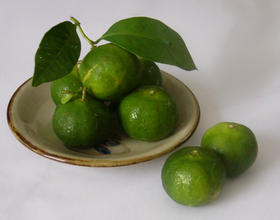 Also written as "shikwasa" or "shikwasa. Japanese name: Hirami lemon, scientific name: Citrus depressa, is an evergreen shrubby citrus fruit of the tangerine family (Wikipedia, the free encyclopedia for scientific names). It is a small citrus fruit native mainly to Okinawa, with greenish skin, highly acidic while unripe, and moderately sweet when ripe to yellow, but still more acidic than the tangerine and similar to the lemon. Typical Shikwasa strains are Ishikunibu (stone 9 years old tree), Husubuta (thick navel), Tanebuto (large seeds), Mikangwa (small tangerine), Ingwakunibu (dog 9 years old tree), Hijakunibu (goat 9 years old tree), Kaaachi (thick skin), Kaabishee (thin skin), etc., and their fruit sizes There are also several other varieties.
Shikwasa was once used as a substitute for detergent to wash bashofu (Japanese banana cloth). In recent years, the nobiletin, a type of flavonoid found in shikwasa, has been attracting attention and has become a popular fruit. In Okinawa, shikwasa is not only a health food, but is also used in many other products from seasonings to confectionaries. Translated with DeepL.com (free version)


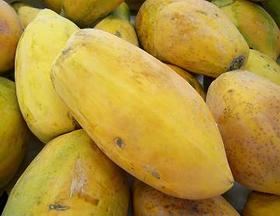 The fruit is a large berry about 15–45 cm long and 10–30 cm in diameter. It is ripe when it feels soft (as soft as a ripe avocado or softer), its skin has attained an amber to orange hue and along the walls of the large central cavity are attached numerous black seeds.
Papaya skin, pulp, and seeds contain a variety of phytochemicals, including carotenoids and polyphenols,as well as benzyl isothiocyanates and benzyl glucosinates, with skin and pulp levels that increase during ripening. The carotenoids, lutein and beta-carotene, are prominent in the yellow skin, while lycopene is dominant in the red flesh. Papaya seeds also contain the cyanogenic substance prunasin. The green fruit contains papain, a cysteine protease enzyme used to tenderize meat. (From Wikipedia)
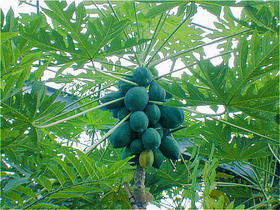
Papayas are dioecious. The flowers are five-parted and highly dimorphic; the male flowers have the stamens fused to the petals. There are two different types of papaya flowers. The female flowers have a superior ovary and five contorted petals loosely connected at the base.
Male and female flowers are borne in the leaf axils; the male flowers are in multiflowered dichasia, and the female ones are in few-flowered dichasia. The pollen grains are elongated and approximately 35 microns in length. The flowers are sweet-scented, open at night, and are wind- or insect-pollinated. (From Wikipedia)
 From Wikipedia, the free encyclopedia
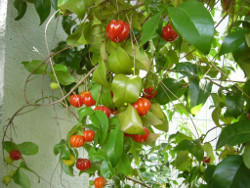
The Suriname cherry, also known as the Brazilian cherry, is a flowering plant belonging to the Myrtaceae family. Its edible fruit is classified as a botanical berry, with flavors ranging from sweet to sour depending on the cultivar and ripeness. The darker red to black fruits are notably sweet, while those in the green to orange range are distinctly tart. The primary culinary application of the fruit is as a flavoring agent and a base ingredient for jams and jellies. Additionally, the fruit is rich in vitamin C and serves as a source of provitamin A.
Eugenia uniflora has several significant pharmacological properties. Its essential oil is antihypertensive, antidiabetic, antitumor and analgesic, and it has shown antiviral and antifungal activity. It has performed against microorganisms such as Trichomonas gallinae (in vitro), Trypanosoma cruzi and Leishmania amazonensis.
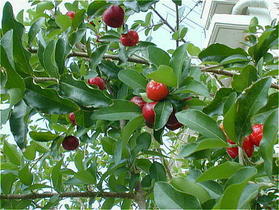 An evergreen shrub native to the West Indies, northern South America, and Central America, it produces edible cherry-like fruits with bright red skins. The leaves are entire (without serrated leaves) and about 10 cm long. The fruits are small (5-8 grams), with red skin and pale yellow or red flesh. The shape of the fruit gives it the alias Barbados cherry, but according to the APG IV classification, the acerola is a member of the Kytranychidae family, which is taxonomically distant from the cherry, which is a member of the Rosaceae family. The fruit can be divided into two types: acidic (sour) and sweet (sweet). Nutritionally, it is rich in vitamin C, which is 17 times richer than that of lemons, and also contains carotene, vitamins B1 and B2, and vitamin E, among others. It is mainly processed into soft drinks, jams, and jellies. However, ripe fruits are rarely sold commercially because they are easily damaged, and unripe fruits are used for processing.
In Japan, it was introduced to Okinawa Prefecture in 1958 and has been cultivated there ever since. Currently, it is sold as a processed product as Nichirei Acerola Drink by Suntory Foods, and is widely used by the general public. It is also used as a beverage in Brazil, where the flavor of the acerola itself can be strongly felt. However, the taste of acerola itself is not so strong in Japanese beverages, as it is diluted considerably. (From Wikipedia Translation is Deepl)
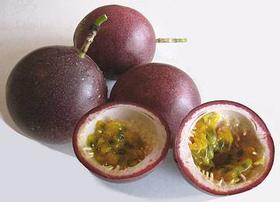 As of 2010, a few dozen species selected and bred for their edible berries are grown in a wide range of tropical and subtropical regions of the world. Brazil is the largest producer, with the majority of cultivation in surrounding Central and South America. It is also cultivated in Taiwan, Indonesia, and other Southeast Asian countries.
In Japan, it has long been cultivated mainly in the Nansei Islands centering on the Amami Islands, the islands of Tokyo, Kagoshima Prefecture, and Okinawa Prefecture. Kagoshima Prefecture is the largest in Japan in terms of both cultivated area and production, but cultivation is also flourishing in Kumamoto, Gifu, Tokyo, Nagano, Tochigi, Fukushima, and other prefectures. Most of these cultivations are done in greenhouses, but open-air cultivation is also possible, and it has been cultivated in many places for a long time. In recent years, it has been cultivated in open fields in Chiba and Gifu prefectures.
In Japan, cultivation is generally divided into three types: purple, yellow, and intermediate hybrids, with the purple variety, which has a strong sweetness, in high demand for fresh eating. The yellow variety is more robust and juicy, and is often grown as a raw material for processing around the world. ー From Wikipedia ー Translated with DeepL.com (free version)
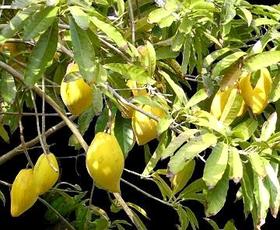 Pouteria campechiana (commonly known as the cupcake fruit, eggfruit, zapote amarillo or canistel) is an evergreen tree native to, and cultivated in, southern Mexico, Belize, Guatemala, and El Salvador. It is cultivated in other countries, such as India, Costa Rica, Brazil, the United States, the Dominican Republic, Australia, Cambodia, Vietnam, Indonesia, Sri Lanka, Nigeria, and the Philippines. The edible part of the tree is its fruit, which is colloquially known as an egg fruit.
The canistel grows up to 10 m (33 ft) high, and produces orange-yellow fruit, also called yellow sapote, up to 7 cm (2.8 in) long, which are edible raw. Canistel flesh is sweet, with a texture often compared to that of a hard-boiled egg yolk, hence its colloquial name "eggfruit". It is closely related to the lucuma, mamey sapote, and abiu. From Wikipedia, the free encyclopedia
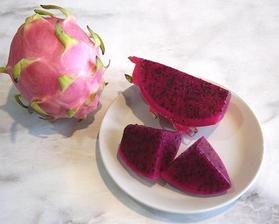 We are uploading dragon fruit in honor of this year's Chinese zodiac sign, the Year of the Dragon. Also known as dragon fruit or pitaya (pitaya is the generic name for the fruit of the cactus). It is the fruit of the sangkak cactus, a member of the family Cactaceae, and originates from Central and South America. The smallest fruit is about the size of a woman's fist, and the largest is about the size of a man's fist. The rind is a bright reddish pink and the flesh is often white and red.
The pulp is jelly-like, and the black seeds are entirely covered like sesame seeds, making it impossible to separate the pulp from the seeds. Therefore, the seeds are eaten with the pulp, so the texture is crunchy. Some dragonfruits have red pulp, while others have yellow-colored rind. (DeepL free version)
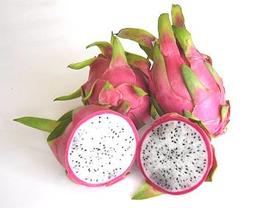
The second photo shows a dragon fruit with white flesh. The color is not as good as expected due to poor photography, but it is clear and beautiful white. The seeds are still sesame-like, so they are eaten together with the pulp.
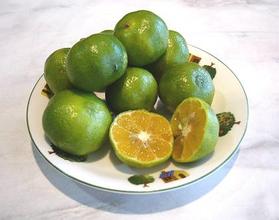 This variety of mikan is the first to be harvested among the Onshu mikans. The very first variety of mikan harvested a little earlier than the normal harvest time is called "aokiri mikan". The skin is green but fragrant, and the fruit is red and sweet. Aokiri mikan is characterized by the fresh acidity of Onshu mikan and is mainly produced in Okinawa, Kagoshima, and Wakayama. (Deepl)
Wenzhou mandarins are a variety of mandarin oranges, and among them, the earliest harvested variety is called "Gokuwase."
Mandarins of this early-harvest Gokuwase variety, picked a little earlier than the usual harvest time, are known as "Aogiri Mikan" or green-peel mandarins. Despite their green peel, they have a strong fragrance, and the fruit is characterized by its red color and sweetness. Aogiri Mikan is known for the refreshing acidity typical of Wenzhou mandarins and is primarily produced in Okinawa, Kagoshima, and Wakayama. (ChatGPT)
The first variety of mandarin oranges to be harvested is the early-ripe variety. The early-ripe variety that is harvested a little earlier than the usual harvest time is called a green-cut mandarin orange. It is characterized by its strong fragrance even with a green skin, and its sweet red fruit. Green-cut mandarin oranges are characterized by the refreshing acidity of mandarin oranges, and Okinawa, Kagoshima, and Wakayama are the main production areas.(Google Bard)
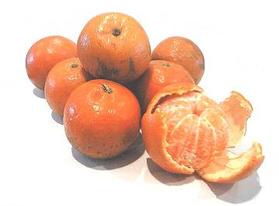 Tankan, a popular citrus fruit in Okinawa. It is a subtropical citrus fruit that prefers high temperatures, and the harvest season is from January to late April. Tankan, which peaks in February, is a winter fruit in the subtropics where there is no snow.
Tankan is characterized by its thick and bumpy skin, with uneven color and black spots mixed in. Due to its thick skin, it can be a bit challenging to peel, but the flesh is orange, soft, and juicy. It is said to have a rich flavor with less acidity than it appears, leaving a lingering sweetness. The photo shows the Tankan I received, and although the season is coming to an end, it is still sufficiently sweet.
Tankan is believed to have originated in Guangdong Province, China, and it was introduced to the Ryukyu Islands, including Okinawa and Amami Oshima, via Taiwan in the late Meiji period. It is said that full-scale cultivation began around 1934 in the Showa era.
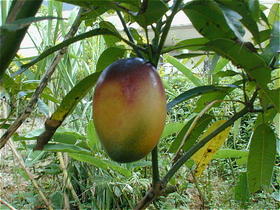 Mangifera indica, commonly known as mango, is a species of flowering plant in the family Anacardiaceae. It is a large fruit tree, capable of growing to a height of 30 metres (100 feet). There are two distinct genetic populations in modern mangoes – the "Indian type" and the "Southeast Asian type". ー Wikipedia ー
It is common to cut the ripe fruit along the seed and consume it raw, but it is also processed into juice, lassi, puree, canned, and dried fruits. In Hong Kong, mango pudding, which combines the pulp or puree with ingredients like gelatin, sugar, and cream, is famous. In addition, Western confectioneries such as mousse, cake, sherbet, smoothies, and gummies are also popularly made. Additionally, unripe fruits are pickled in salt, sweet and sour pickles, or chutney. In Southeast Asia, unripe fruits are soaked in chili-infused sugar salt and consumed, or used in dishes like stir-fries.
In terms of nutrition, mangoes are particularly rich in carotenes, and contain a lot of Vitamin A and Vitamin C, with expected antioxidant effects. They also contain folic acid, which helps prevent anemia and mouth sores.
Mangoes contain a substance called 'mangiferin,' similar to urushiol, which can cause contact dermatitis (itchiness). It is important to be cautious, as it can lead to a high incidence of rashes. Symptoms of rash, including itching and eczema, may develop and worsen several days after consumption and can sometimes be misdiagnosed as herpes or similar conditions. - From Wikipedia -

The top mango-producing prefecture in Japan is Okinawa, known for its subtropical climate ideal for growing mangoes. The main cultivated varieties are Apple Mango (Irwin variety) and Keitt Mango. Apple Mango is primarily shipped from late June to early August, with a sugar content of around 15 degrees and a distinctive red appearance.
Keitt Mango is characterized by its green skin remaining even when fully ripe. It is low in fiber and sweet. The harvest period is later than that of Apple Mango, with shipments typically occurring from August to October.


 Mail
Mail