◎ Style Change:
◎ This post was translated from Japanese with translation software.
Nankotsu soki Soba
2020.07.05
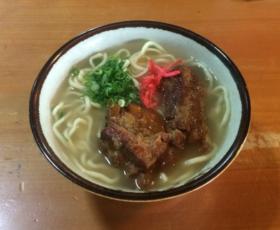 In Okinawan soba, there is a type of soba that is topped with "soki" (pork ribs with meat) and "nankotsu soki" (pork ribs with cartilage). While nankotsu soki soba is also delicious in its own right, personally, I still prefer soki. Nankotsu soki refers to pork ribs with cartilage included. Whether it's nankotsu soki or regular soki, the meat is simmered for a long time until it becomes tender.
When you fill your belly with an extra-large portion of nankotsu soki soba, eventually, the fat from the nankotsu soki slowly reaches every nook and cranny of your body through the cartilage, giving you a pleasant sensation (known as "andai" in the Okinawan dialect). Taking a short nap in the cool shade of a tree, it truly is a moment of bliss!


Okinawa tempura
2020.05.11
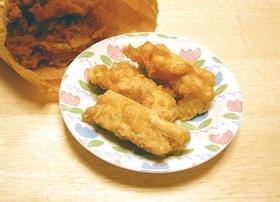 Tempura in Okinawa is characterized by a slightly hard and thick batter. Because of the subtropical climate, the core (filling) of the tempura is easily damaged. Therefore, I believe that the batter is thickened to make the tempura last longer. (Photo left 1: Fish tempura)
Decades ago, on my first trip to the mainland, I remember being a bit surprised at the thin batter, crispiness, and sweetened tempura sauce served at a ryokan meal. After all, tempura was served with a thick batter, and I was a little surprised to find that it was served with soy sauce or sauce.
The core (or "neta") of Okinawan tempura consists mainly of fish, squid, potatoes, and vegetables (carrots, onions, and leeks). Tempura is an indispensable part of daily life in Okinawa, and is usually eaten at three o'clock in the morning, in addition to being used to fill stacked boxes for celebratory events and seasonal occasions.
Okinawa Soba
2020.04.16
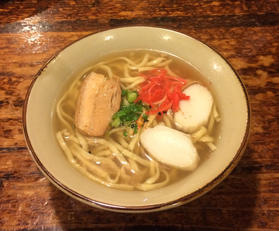 In Okinawa, the word "buckwheat" refers to Okinawa soba, which is made without buckwheat flour. The ingredients for Okinawa soba are strong (or medium-strength) buckwheat flour, salt, brine, or lye (the clear liquid from the ashes).
Buckwheat noodles are rarely made at home, and fresh noodles sold in supermarkets are used. There are various types of buckwheat noodles, including flat, thick, frizzled, and un-frizzled noodles, and it is up to you to decide which type you prefer. The most common type of noodle is a little thicker and lightly frizzled. The soup is made from pork bones and bonito stock, seasoned with salt and soy sauce. It is often eaten at restaurants rather than as a home-cooked meal, and is so popular that there are magazines that guide you to the best buckwheat noodles in the area. It is delicious with a variety of toppings.
The history of Okinawan buckwheat is not certain, as there are various theories, but it is said to have been the food of a very few wealthy people during the Kingdom of the Ryukyus. It was not until the late Meiji period (1868-1912) that the common people were able to eat it, and it is said that today's buckwheat noodle shops originated in the Kaminokura, Nishimachi, Higashimachi, and Tsuji areas in Naha. It is said that it was only after the popular Soki soba war that stores began to add meat and kamaboko (fish paste) to their buckwheat noodles, as if they were competing with each other, instead of just noodles and soup.
After the reversion to Japan, the name of buckwheat without buckwheat flour was considered problematic, but thanks to the efforts of related organizations, on October 17, 1978, it was labeled "Honjo Okinawa soba" in the appended table of the Fair Trade Council's "Fair Competition Enforcement Regulations Concerning Labeling of Fresh Noodles". To commemorate this event, October 17 is designated as "Okinawa Soba Day.
Soki Soba
2020.03.04
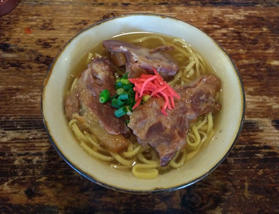 The ingredients for Okinawa soba are strong (or medium-strength) flour, salt, brine, or lye (the clear liquid of ashes). It is not common to make buckwheat noodles at home, but fresh noodles sold in supermarkets are used.
There are various types of buckwheat noodles, including flat, thick, frizzled, and un-frizzled, and it is up to you to decide which you prefer. The most common type of noodle is a little thicker and lightly frizzled. The soup is made from pork bones and bonito stock, seasoned with salt and soy sauce.
It is often eaten at restaurants rather than as a home-cooked meal, and is so popular that there are magazines that guide you to the best buckwheat noodles in the area. It is delicious with a variety of toppings.
The history of Okinawan buckwheat is not certain, as there are various theories, but it is said to have been the food of a very few wealthy people during the Kingdom of the Ryukyus. It was not until the late Meiji period (1868-1912) that the common people were able to eat it, and it is said that today's buckwheat noodle shops originated in the Kaminokura, Nishimachi, Higashimachi, and Tsuji areas in Naha. From just noodles and soup, each store competes to offer a wide variety of buckwheat noodles, including meat, kamaboko, soki, foot tebichi, meat soba, filling, vegetables, and more.
Rafté
2020.02.02
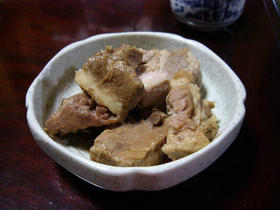 Rafté is a dish in which pork is stewed until tender. It is similar to stewed pork cubes and is indescribably delicious.
Wash a chunk of pork (or pork loin) in hot water and boil it for 30 to 40 minutes, removing the scum. After boiling, remove from the pot, let cool slightly, and cut into pieces about 6 cm wide and 2 cm thick (this is just a rough guide).
In a separate pot, make a stock with broth, soy sauce, sugar, awamori, and ginger, add the sliced pork, and simmer over high heat for 5 to 6 minutes at first, then lower the heat to low (about 1 to 2 hours, until it can be torn with chopsticks).
Su chikhá
2020.01.02
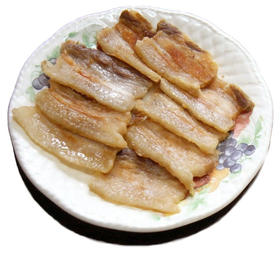 In the olden days, when there were no refrigerators, pork was pickled in salt as a means of preservation. The salted pork is called Su chikhá. Su" means salt (or simply salt (maas)), and "chikha" means pickled.
When one thinks of salted meat, one tends to imagine that it might be salty, but when well seasoned, it is quite tasty. Grill the meat on a grill and lightly rub the surface of the Su chikhá over the meat. The crispy outside and the juicy texture of the meat allows you to taste the concentrated flavor of the pork. There is no greasy taste, and a good flavor spreads in the mouth.
A light sprinkling of black pepper and a sprinkling of a little bit of seokwasa (or lemon) on grilled Su chikhá makes a great snack to accompany alcoholic beverages. Su chikhá is not only a great snack, but also a great ingredient in chanpuru dishes, and using Su chikhá makes for a traditional chanpuru.
Spareribs
2019.12.10
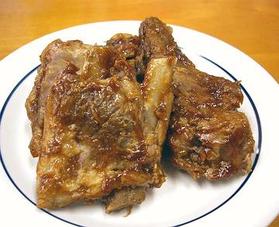 Generally, it refers specifically to the bone-in ribs of pork or cooked pork. It is also a relatively inexpensive portion.
In the Okinawan dialect, it is called soki and is an important ingredient in Okinawan cuisine. In Chinese cuisine, it is called "排骨" (pronounced "pai koo" or "pai ko") and is served over rice or noodles.
In the U.S., it is commonly served as barbecue, with each family having its own special sauce for spare ribs, and competitions are often held to determine which one is the best.
Soki" is an accent of "suki," and since the ribs of a pig resemble a comb, the ribs are also called "soki. It is also called "Soki Bone (Buni)" because it has bones, and it is eaten as "Soki Jiru (Soki Soup)", a soup stewed with kombu, radish, and wax gourd, or as "Nizuke (Braised)" with kombu, radish, tofu, etc. It is also used as an ingredient in Okinawan soba noodles. Soki is also used as an ingredient in Okinawa soba, and Okinawa soba with soki on top is called "Soki soba.
The traditional method is to slowly boil pork ribs in water for a long time, discard the boiling water, wash the meat, and then simmer it again for a long time in a new broth made of soy sauce, awamori, brown sugar, kombu, bonito dashi, and other seasonings to soak up the flavor. In recent years, pressure cookers are also commonly used. (From Wikipedia above).
Chap Steak
2019.11.09
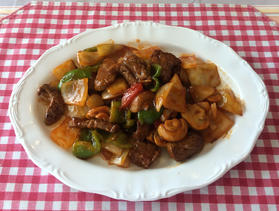 Chap Steak, a menu item at Seaside Drive-In in Onna Village The following is from Wikipedia.
This dish is very similar to hapo-shi, also known as chap sui. Details vary from region to region and from restaurant to restaurant, and sometimes tomatoes and ham are used as ingredients unique to North America.
It is a staple of take-out Chinese cuisine in the rural United States and Canada, and is also widely served in Chinese restaurants in South America and India. American chap sui (English version), popular in the United States from the 1910s to the 1920s, is made by stir-frying chopped onions and bell peppers with ground beef and adding macaroni and tomatoes, and has little in common with chap sui except that it is a mixed stew.
The photo is of a chap steak, not a chap suey. I ordered it because it was on the drive-in menu, and to my delight, it was riddled with cuts of beef.
Pork Egg
2019.10.10
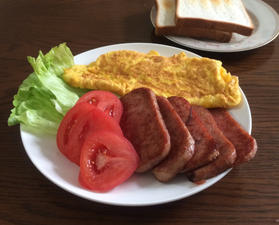 It is no exaggeration to say that pork tamago has revolutionized Okinawan dining. It is a delightful dish that can be easily prepared with an omelet, stir-fried pork, and any vegetables you have on hand.
It is a dish that can be made quickly in the busy morning hours, so at best it is reasonable, at worst it is a lazy dish. However, no matter what you call it, it is surely a very useful menu item.
Eggs can be fried or scrambled as you like; today it's soup and bread, but rice and miso soup would also be delicious. It is good not only for breakfast, but also for lunch, and sometimes even for dinner.
It is so familiar in Okinawa that you can even find it on the menu of a popular diner. It is a familiar dish in Okinawa, so much so that it is even on the menus of popular restaurants. A little while ago, there was Okinawan soba in the school cafeteria, and instead of three pieces of meat, which was the filling of the soba, it was pork, which was unique to the inexpensive school cafeteria.
These days, pork is an ingredient in 100-yen soba noodles sold at lunchbox shops and in the prepared foods section of supermarkets.
Chinese-style fried rice
2019.09.05
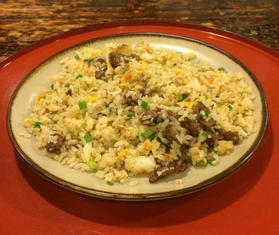 Although it is classified as one of the Chinese dishes, it is a universal cooking method in regions where rice is the staple food, and is not necessarily influenced by Chinese cuisine. In Japanese, it is also called yakisimeshi (fried rice), but it is sometimes interpreted that only Chinese-style yakisimeshi is called fried rice. (From Wikipedia)
Similar dishes include paella (a popular Spanish dish), in which raw rice is stir-fried and then boiled, and pilaf (said to have originated in the Middle East; Turkish cuisine is famous), in which stir-fried raw rice is cooked.


 Mail
Mail