◎ Style Change:
◎ This post was translated from Japanese with translation software.
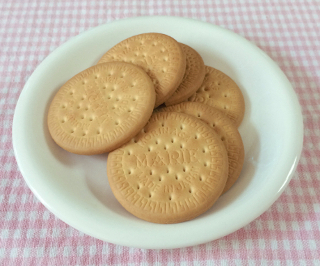 A biscuit, in most English speaking countries, is a flour-based baked and shaped food product. Biscuits are typically hard, flat, and unleavened. They are usually sweet and may be made with sugar, chocolate, icing, jam, ginger, or cinnamon. They can also be savoury, similar to crackers. Types of biscuit include sandwich biscuits, digestive biscuits, ginger biscuits, shortbread biscuits, chocolate chip cookies, chocolate-coated marshmallow treats, Anzac biscuits, biscotti, and speculaas.
In most of North America, nearly all hard sweet biscuits are called "cookies", while the term "biscuit" is used for a soft, leavened quick bread similar to a less sweet version of a scone.
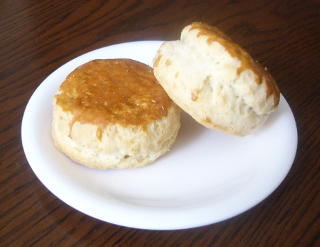 In the United States and some parts of Canada, a "biscuit" is a quick bread, somewhat similar to an unsweetened scone, but with a texture more 'fluffy and flaky' vs. 'sturdy and crumbly'. Biscuits may be referred to as either "baking powder biscuits" or "buttermilk biscuits" if buttermilk is used rather than milk as a liquid, as buttermilk is not only flavorful but acidic (allowing use of baking soda vs. baking powder which is a mixture of baking soda with an acidifier and buffer). A Southern regional variation using the term "beaten biscuit" (or in New England "sea biscuit") is closer to hardtack than soft dough biscuits.

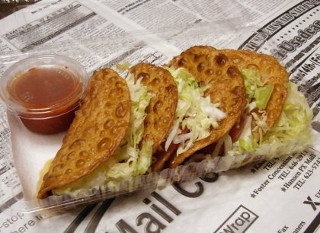 A taco is a traditional Mexican food consisting of a small hand-sized corn- or wheat-based tortilla topped with a filling. The tortilla is then folded around the filling and eaten by hand. A taco can be made with a variety of fillings, including beef, pork, chicken, seafood, beans, vegetables, and cheese, allowing for great versatility and variety. They are often garnished with various condiments, such as salsa, guacamole, or sour cream, and vegetables, such as lettuce, onion, tomatoes, and chiles. Tacos are a common form of antojitos, or Mexican street food, which have spread around the world.
 Tacos can be contrasted with similar foods such as burritos, which are often much larger and rolled rather than folded; taquitos, which are rolled and fried; or chalupas/tostadas, in which the tortilla is fried before filling.
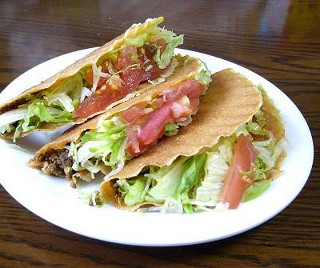 The hard-shell or crispy taco is a tradition that developed in the United States. The most common type of taco in the US is the hard-shell, U-shaped version, first described in a cookbook in 1949.[23] This type of taco is typically served as a crisp-fried corn tortilla filled with seasoned ground beef, cheese, lettuce, and sometimes tomato, onion, salsa, sour cream, and avocado or guacamole.
Traditionally, soft-shelled tacos referred to corn tortillas that were cooked to a softer state than a hard taco – usually by grilling or steaming. More recently, the term has come to include flour-tortilla-based tacos mostly from large manufacturers and restaurant chains. In this context, soft tacos are tacos made with wheat flour tortillas and filled with the same ingredients as a hard taco.
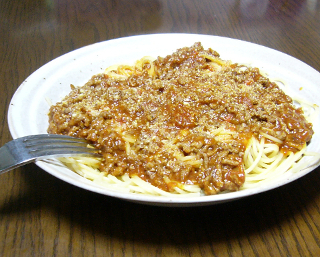 In cooking, al dente (Italian pronunciation: [al ˈdɛnte]) describes pasta or rice that is cooked to be firm to the bite.
・Vongole rosso: scallion and tomato sauce. Vongole means clams and rosso means red.
・Vongole bianco: clams and white wine. Vongole is for clams and bianco is for white.
・Bolognese: meat sauce. From the word "Bolognese," meaning "from Bologna.
・Arrabiata: tomato sauce, garlic, hot peppers, olive oil. Arrabbiata means "to be angry. It is named for its spicy, red face.
・Pescatora: seafood with tomato sauce. Pescatora means "hunter's style".
・Amatriciana: a sauce based on crispy bacon, whole tomatoes and red peppers. Sometimes called "amatriciana," amatriciana means "in the style of Amatrice, a town in the province of Lazio.
・Puttanesca: tomato sauce with black olives, capers and anchovies. Prostitute style. In Italy, it is called this because it is so delicious that prostitutes use it to tout their wares.
・Pomodoro: tomato sauce. Pomodoro means tomato.
・Carbonara: eggs,cream,bacon. Carbonara is "charbroiled style" and "charbroiled artisan".
・Boscaiola: a dish made with mushrooms. Boscaiola is "lumberjack.
・Peperoncino: chili peppers, garlic and olive oil. Peperoncino is also called "pasta of despair" because it has so few ingredients.
・Genovese: basil, pine nuts, garlic. Genoa in Liguria, Italy is famous for its basil. A paste made by grinding basil, pine nuts, and garlic is called pesto alla genovese.
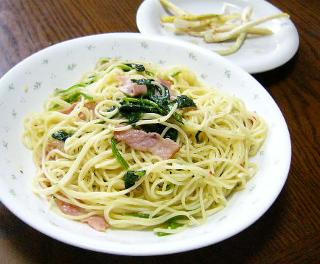 Pasta is a food product made mainly from durum wheat semolina flour. It can be broadly classified into two types: small, short pasta such as macaroni and long, noodle-like pasta such as spaghetti. There are also dumpling- and board-shaped pasta.
○Long pasta
・Spaghetti is a long, round pasta dish commonly referred to as spaghetti. Spaghetti is also known as spago (spago string).
・Fettuccine is one of the long pastas familiar in Japan, often referred to as "crepe-like pasta".
・Fettuccine is one of the long pasta, often referred to as "fettuccine" in Japan.
・Bucatini is a long, tubular pasta that is thicker than spaghetti (2 to 3 mm in diameter) and has a hole in the center.
・Capellini is a long, thin pasta with a diameter of 0.9 mm.
・Linguine is flat but oval in cross section, not just thinly sliced like fettuccine.
○Short pasta
・Maccheroni is a well-known tubular macaroni pasta. Maccheroni is a short pasta with holes about 4 mm in diameter, although the thickness varies slightly.
・Penne is a tubular pasta with a diameter of about 6 mm, cut diagonally at both ends. Penne means pen nibs.
・Farfalle is a ribbon-shaped short pasta whose name comes from the meaning of butterfly.
・Rigatoni is a thick, cylindrical pasta about 2 cm long with a straight groove on the outside.
・Conchiglie is a short pasta, also called shell. It is similar to dry pasta gnocchi, but has thin, narrow stripes on the outside instead of steps.
・Gnocchi are not gnocchi, but short pasta without potatoes, which are often available in dried form. Gnocco means "dumb and silly.
・Lasagne is a commercially available dried type of pasta that is usually about 20 cm long and less than 10 cm wide.
・Ravioli are small, square pasta with stuffing.
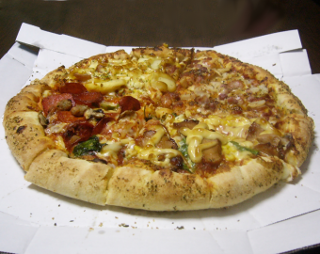 Pizza or pizza (Italian: pizza) is a dish of Italian origin made by kneading flour, water, salt, and yeast, fermenting the dough, rolling it out into a thin round shape, topping it with tomatoes, cheese, and various other ingredients (anchovies, mushrooms, onions, olives, other vegetables, meat, etc.), and baking it in an oven or special It is a dish that originated in Italy. (It has its origins in Egypt).
Smaller versions are sometimes called pizzetta (Italian: pizzetta) to distinguish them from the larger ones.
Classification of Pizza by Ingredient
・Margherita: Basilico, mozzarella and tomato sauce.
・Marinara: Sailor style, garlic, olive oil, tomato sauce. Garlic, olive oil, tomato sauce.
・Quattro formaggi: four kinds of cheese.
・Quattro Stagioni: with seasonal ingredients.
・Boscaiola: a lumberjack style. Boscaiola: Boscaiola is made with mushrooms from the mountains.
・Romana: Roman style pizza.
・Napoletana: Neapolitan style. Napoletana: Neapolitan style, but not Neapolitan pizza.
・Bismarck: Pizza with a half-boiled fried egg in the center.
The name derives from the fact that one of Prussian Prime Minister Bismarck's
favorite foods was steak with a fried egg on top.
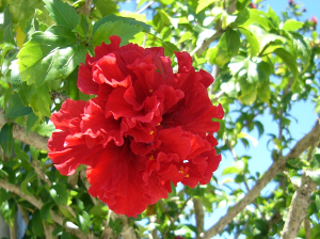 Hibiscus is a genus of flowering plants in the mallow family, Malvaceae. The genus is quite large, comprising several hundred species that are native to warm temperate, subtropical and tropical regions throughout the world. Member species are renowned for their large, showy flowers and those species are commonly known simply as "hibiscus", or less widely known as rose mallow. Other names include hardy hibiscus, rose of sharon, and tropical hibiscus. (From Wikipedia, the free encyclopedia)
It is one of the flowering trees that represents Okinawa, strong and fast growing and sturdy for the strong wind in Okinawa. Its branches stretch out straight, and the tree grows to be about 10 feet tall. For many years it has been frequently used in graveyards and for offerings at family tombs. Therefore, it is sometimes called “After Ages Flower” (Gusohbana). It is also often used as hedges around residences. There apparently was also a time when it was valued for various purposes such as for feeding goats and making shampoo.
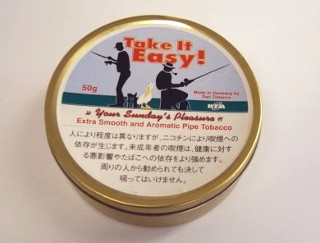 Since the subtitle of my blog is Take it eazy, I pasted a photo of me when I used to smoke pipe tobacco.
"Take It Easy" is a rich blend of aromatic pipe tobacco in the oriental fragrance category. The catalog describes it as a blend with a robust flavor that carries a fruity sweetness. It features a strong aroma with hints of wild strawberry, passion fruit, and coconut. However, the overall strength of the blend is moderate, making it suitable for casual enjoyment. It offers a balanced product with a certain level of kick and vitality.
When you actually open the tobacco tin, you're greeted with a fruity, sweet aroma. When packed into the pipe and lit, even for an aromatic pipe tobacco, there's a notably pleasant sweetness and a distinct fruity essence. It's been quite a while since I quit smoking, but every now and then, during those casual moments of idle contemplation, the scent comes to mind.
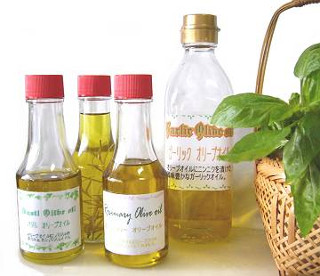 In the kitchen garden, the kitchen is small, with only four small pots containing parsley, thyme, basil, and so on. I trimmed the basil and rosemary plants a little because they had grown too tall. I soaked the pruned leaves in olive oil.
Herb-infused olive oil is a great finishing touch for dishes. Additionally, preparing garlic oil by soaking peeled garlic cloves in olive oil is a fantastic way to enhance stir-fries and meat dishes. You can use around 7-8 cloves of peeled garlic in 350cc of olive oil, and it will be ready for use after about 10 days of soaking. However, if you leave the garlic in the oil for over a month, it may start to cloud, so it's best to strain it before using.
From right to left, we have garlic-infused olive oil, two sprigs of rosemary, and basil-infused olive oil. I used pure oil for the garlic and rosemary, and extra virgin for the basil and the other sprig of rosemary. The process is quite simple. I filled separate bottles with about 200cc of olive oil, added 2-3 basil leaves, and about two sprigs of rosemary. After about 10-15 days, the oil takes on the fragrance. It's important to ensure that the leaves are completely submerged in the olive oil to prevent them from sticking out. After a few days with the herbs in, the oil may become slightly cloudy. Filtering it through a coffee filter will yield a clear and beautiful oil.
Sprinkling basil oil as a finishing touch on a simple pizza toast creates a fragrant and luxurious flavor, elevating the toast to a rich and aromatic delight.
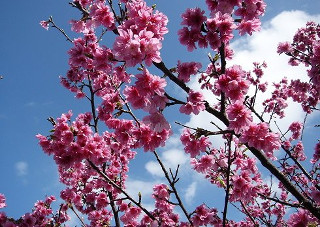 Prunus campanulata is a species of cherry native to Japan, Taiwan, southern and eastern China (Guangxi, Guangdong, Hainan, Hunan, Fujian, and Zhejiang), and Vietnam.[4] It is a large shrub or small tree, growing 3–8 m (10–26 ft) tall.[4] It is widely grown as an ornamental tree, and a symbol of Nago in the Ryukyu Islands of Japan. It is variously known in English as the Taiwan cherry,[5] Formosan cherry, or bellflower cherry.
 In Japan, it is considered a horticultural variety, but it has become wild mainly in Okinawa Prefecture. When people in Okinawa say "sakura" (cherry blossom), they are referring to this Kanhi Zakura, which blooms from January to February.
The Japanese name hikanzakura (meaning "scarlet cherry blossom") is derived from the scarlet color of the blossoms. Since this name is confusing with higanzakura, it is also called kanhizakura (寒緋桜). In Okinawa, it is commonly called "sakura" and is used for schools, parks, and rows of trees. The earliest "cherry blossom festival" in Japan, which begins in mid-January every year in Motobu Town and Nago City, has become famous. Most of the cherry trees planted in the prefecture are seedlings, and there is a great deal of variation among individuals in terms of uneven flowering period and flower color shade, so the spread of grafted seedlings made from selected individuals is being considered.
- From the website of the Environmental Restoration Division, Environment Department, Okinawa Prefecture -

Easy come, easy go. (得やすいものは失いやすい。)
That's easy enough. (どうってことない。)
I think I need to take it easy for a while.
(しばらくの間、少しのんびりしたほうがいいと思うな。)
I am just going to take it easy for a couple of days. (2、3日ゆっくりする。)


 Mail
Mail